Pattern recognition is the quiet muscle behind faster, more confident puzzle solving. Whether you prefer word ladders, logic grids, nonograms, or browser-based brainteasers, the same small set of visual and logical habits will pay dividends. This article lays out core techniques you can apply immediately, with short drills to build them into your solving routine.
Why pattern recognition matters
At its simplest, pattern recognition turns clutter into a few reliable cues. Instead of trying every possibility, you learn to notice repeating shapes, forced placements, symmetry, and contradictions. Those cues reduce the search space, reveal leverage points, and let you plan two or three moves ahead without exhaustive trial and error.
Key techniques and how to practice them
1. Symmetry spotting
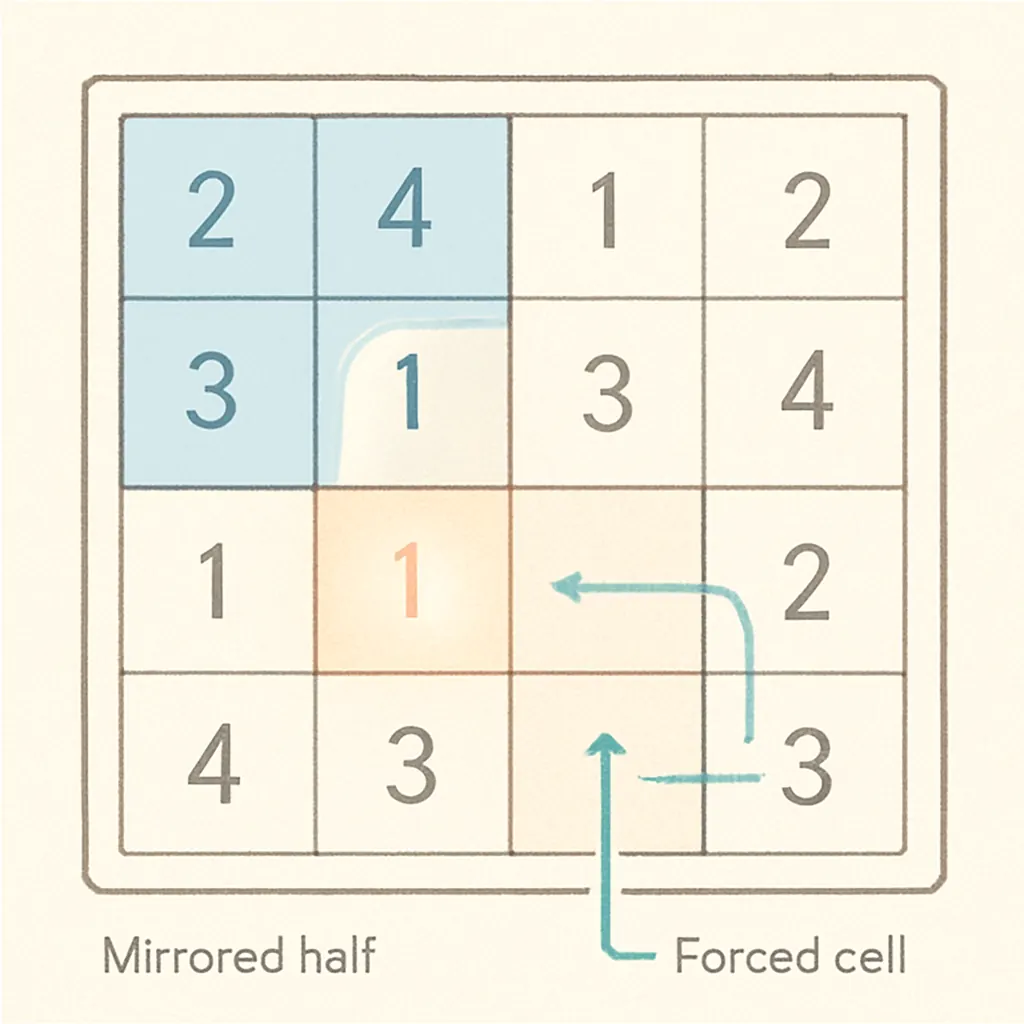
Many puzzles either include explicit symmetry (a grid that’s mirrored) or implicit symmetry created by identical constraints. Symmetry often means that a finding on one side transfers to the other, or that a single ambiguity will resolve symmetrically.
- How to use it: Before you make a move, scan for mirrored regions or repeating rows/columns. Ask: if I place X here, does an equivalent placement exist elsewhere?
- Quick drill: Take small 10×10 nonograms or picture logic puzzles and cover the right half. Solve the left half first, then uncover the right and compare. Practice predicting placements based on mirrored clues. This builds an instinct for when symmetry will carry through.
2. Forced-move detection
A forced move is a placement or elimination that follows from the rules with no alternative. Recognizing forced moves early prevents wasted guessing and creates chains that simplify the puzzle.
- How to use it: Look for cells or options that would violate a rule if left open. In a word puzzle, a letter that would block all possible words is forced; in a logic grid, a relationship that removes every alternative is forced.
- Quick drill: Pick five logic-grid-style clues and try to find every deduction that’s absolutely forced before you make any tentative assumptions. A good use-case for this technique is in logic grid deduction patterns, where forced assignments cascade rapidly.
3. Constraint propagation
Constraint propagation is the practice of tracking how one placement narrows possibilities elsewhere and applying those restrictions repeatedly until nothing new appears. It turns local observations into global progress.
- How to use it: After making a placement, update related rows, columns, or variables immediately. Re-evaluate constraints until the puzzle reaches a steady state.
- Quick drill: On a medium nonogram (or a similar grid puzzle), place one obvious block and then list every cell whose state must change as a result. Repeat until no cells change. For a step-by-step approach, see nonogram solving steps.
4. Chunking and template matching
Chunking is recognizing common subpatterns—short sequences of filled and empty cells, typical letter clusters, or recurring shape motifs. Template matching is comparing the local area to a known pattern and applying the known consequences.
- How to use it: Build a mental library of small patterns (e.g., a 3-cell run with two definite fills and one uncertain cell) and the consequences they imply. When you see that shape, apply the learned result instead of re-deriving it.
- Quick drill: Save a screenshot of five small patterns you encounter in puzzles and write the rule that made each decisive. Review the list weekly to make those templates second nature.
5. Edge and boundary reasoning
Edges are powerful because they have fewer neighbors. Many puzzles force specific behavior at borders—filled runs must start or end near an edge, or certain letters must appear in corner positions of a grid.
- How to use it: Check edges early. If a row or column has narrow space, start there; those constraints often yield clean starting placements.
- Quick drill: In any grid puzzle, begin your solve by inspecting every border row and column and listing the immediate deductions you can make. Doing this for ten puzzles will show how often the edge contains the first useful move.
Combining techniques: short workflow
- Scan for symmetry and repeating structures.
- Mark immediate forced moves (including edge consequences).
- Propagate constraints from every new placement until stable.
- Look for familiar chunks or templates to speed repetitive work.
- If progress stalls, re-scan for less obvious symmetries or chain reactions.
This lightweight workflow is useful across many puzzle types. For example, nonograms reward early edge reasoning and constraint propagation; logic grids reward forced-move detection and template use for common deduction forms.
Micro-practice plan (10 minutes a day)
Consistency beats intensity. A short, focused daily routine will internalize these techniques far faster than infrequent marathon sessions.
- Minute 0–1: Quick scan. Open any puzzle and identify one symmetry, edge constraint, or obvious forced move.
- Minute 1–6: Focused work. Apply constraint propagation from that observation until you reach a natural pause.
- Minute 6–9: Template check. Ask whether any local shapes match templates you know. If none, note one new pattern to remember.
- Minute 9–10: Reflect. Jot a one-line note: what pattern helped, and what you’ll practice next time. A routine like this slots easily into a broader habit plan such as daily practice routines.
Final tips for durable pattern sense
- Keep a short pattern log. Over time you’ll notice which templates recur in your favorite puzzle types.
- Use screenshots. Visual memory for small shapes is stronger when paired with an image you can review.
- Mix puzzle types. Transferring a pattern from one genre (say, nonograms) to another (like certain grid logic puzzles) sharpens abstraction skills and prevents overfitting to one format.
Pattern recognition is less about raw talent and more about deliberate exposure and repetition. Use the drills above, follow the short workflow, and you’ll find puzzles that used to feel slow become strikingly transparent. If you enjoy deduction-heavy puzzles, you may also like exploring specific deduction strategies in logic grid deduction patterns and step-by-step visual techniques in nonogram solving steps.