Tag: notation

  • Quiet Strategy: How to Break Tough Puzzles Without Stress

    Quiet Strategy: How to Break Tough Puzzles Without Stress

    Why calm matters more than speed

    Tension rarely helps a stuck puzzle. When you feel urgency or frustration, attention narrows and mistakes increase. The aim of this playbook is not to force a solution faster, but to change how you approach a block so progress becomes likely and enjoyable again. Use these steps as a short, repeatable routine whenever you find yourself circling the same dead ends.

    Quick calming steps (1–3 minutes)

    1. Stop and breathe: close your eyes for one minute and breathe slowly. This removes the immediate spike of emotion and resets focus.
    2. Switch posture: stand or stretch for 30 seconds. Changing physical state often changes mental state.
    3. Set a tiny goal: promise yourself one micro-action: read one constraint, test one hypothesis, or mark one small area of the puzzle. Tiny goals reduce pressure.

    Read the puzzle again a different way

    When stuck, the surface reading of the puzzle can blind you to useful structure. Try one of these short re-reads:

    • Reverse read: start from the last step or the final constraint and read backwards. This can reveal consequences you missed.
    • Read for negatives: scan for what is not allowed. Noticing exclusions often frees up space for new deductions.
    • Summarize aloud: explain the current facts out loud in one sentence. The act of verbalizing clarifies assumptions.

    Do one micro-test

    A micro-test is a tiny experiment that costs almost nothing but provides definite information. Think of it like dipping a toe in the water before committing.

    1. Pick a single cell, line, or variable you aren’t sure about.
    2. Assume one option for that item and follow only immediate, forced consequences (no long hypotheticals).
    3. If you reach a quick contradiction, mark that option as impossible; if not, record the consequences and step back.

    Micro-tests are low-arousal because they avoid wandering into deep hypotheticals. They give clear yes/no feedback fast, which reduces uncertainty and builds forward motion.

    Use notation to simplify the complex

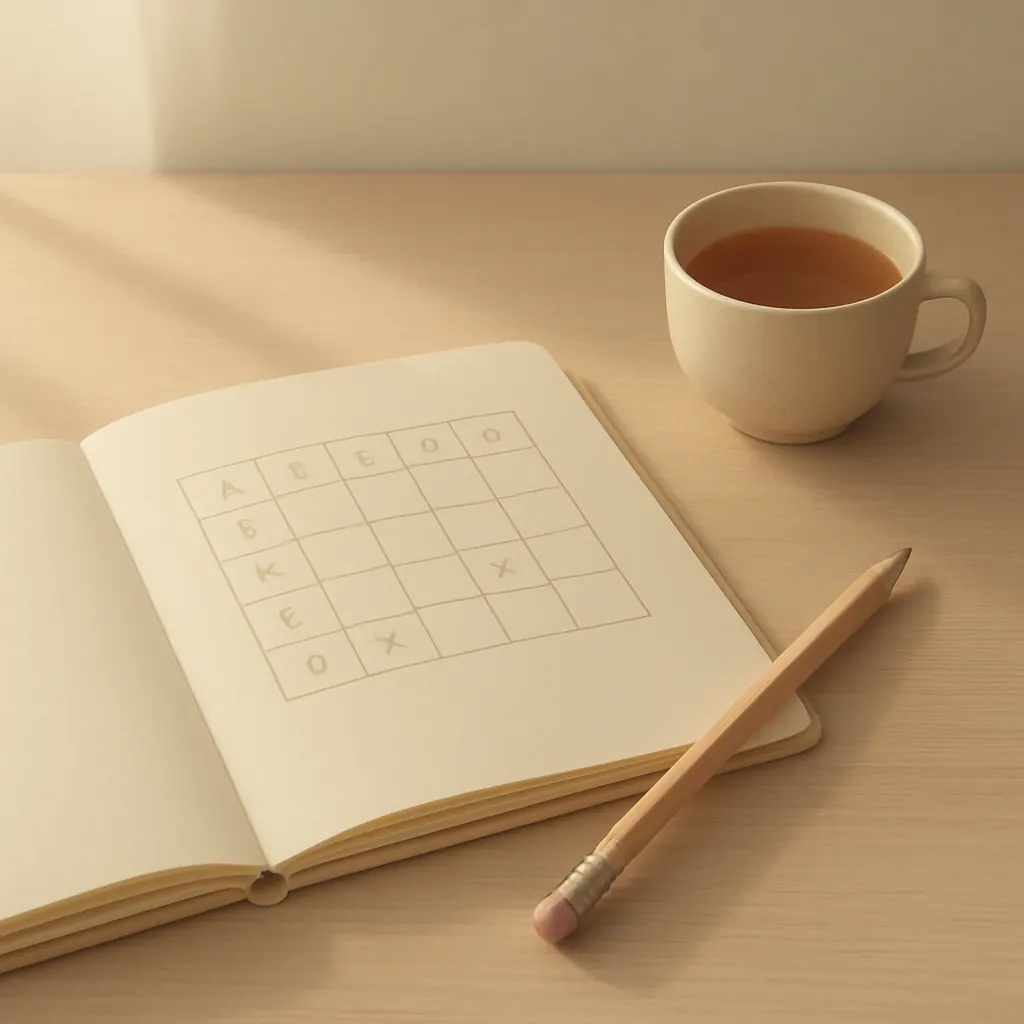
    When puzzles have many interlocking constraints, a small change in how you notate information can make chains of logic visible. Consider shorthand marks, tiny diagrams, or a separate column for “hard facts” vs. “soft possibilities.” If you want concrete notation ideas that help when you’re stuck, try this guide: notation for breaking hard puzzles.

    Structured backtracking: track branches without going crazy

    Uncontrolled backtracking is exhausting. Use a tidy method so you can explore alternatives without losing the work you’ve done.

    1. Label your checkpoints: give a short note to the puzzle state before you try a risky assumption (example: “A: assume X at cell 5”).
    2. Limit depth: allow only one or two levels of assumption at a time. If you need more depth, it’s likely time to pause and review instead.
    3. Keep a one-line log: on scrap paper, record the assumption and the decisive result (contradiction, partial progress, or no effect). This stops you repeating the same failed branch later.

    Micro-session routine for a stuck puzzle (5–12 minutes)

    1. Pause, breathe, one physical stretch (1–2 minutes).
    2. Quick re-read of the last three deductions you made (1–2 minutes).
    3. Choose one micro-test and run it to conclusion (2–4 minutes).
    4. If no result, take a 2-minute break and either switch to another small puzzle or use a reset routine. If you want ideas for timed micro-resets, see: use short resets to overcome blocks.

    When to ask for calm help

    Getting another person involved can be very effective, but keep it low-competition. A good cooperative prompt is: “I’m stuck at this fact; can you read the last three clues and tell me if you see a consequence I missed?” This frames the interaction as mutual discovery rather than a test. For approaches that keep collaboration gentle and constructive, review these cooperative solving techniques.

    Small habits that prevent long blocks

    • Work in short chunks: 12–25 minute sessions keep focus sharp and make backtracking less costly.
    • Record forced moves: when a deduction is forced, mark it clearly so you don’t question it later.
    • Review mistakes calmly: when you do hit a contradiction, treat it as information: what assumption led there, and how will you mark that off in future?

    Final note: be curious, not desperate

    The quiet approach is about curiosity and small experiments, not brute force. Each micro-test, careful notation change, and brief reset reduces the mystery a bit. Over time these tiny wins build a habit of steady, relaxed progress. Use the routines here the next time you feel stuck; aim for slow, visible improvement rather than immediate victory.

    Simple checklist before you proceed

    • Breathe and change posture.
    • Re-read for negatives and reverse consequences.
    • Run a single micro-test and log the result.
    • Use clear notation and label checkpoints.
    • If needed, try a calm cooperative read or a short reset.
  • Handy Notation Tricks for Solving Logic Grid and Deduction Puzzles

    Handy Notation Tricks for Solving Logic Grid and Deduction Puzzles

    Why notation matters

    Notation is the bridge between what you read on a puzzle and the deductions you make. Small, consistent marks outside of your main grid keep the grid tidy and the reasoning visible. Good notation reduces re-checking, prevents errors, and helps you calm the pace of your solving. When you learn to use notation to simplify tough puzzles, the hardest parts of a puzzle become easier to isolate.

    Core principles for any system

    • Be consistent: A mark should always mean the same thing. If a dot means “possible,” don’t flip it to mean “confirmed” later.
    • Prefer small, repeatable symbols: X, O, >, =, and numbers are quick to write and easy to scan.
    • Keep the main grid clean: Use the grid for firm assignments and eliminations; use margins and micro-maps for tentative notes.
    • Make conditional notes readable: Short, clear phrases or arrowed shorthand help later review (“If A–B, then C≠D”).

    Shorthand marks that save time

    Below are compact marks I use and recommend practicing. Choose one symbol for each meaning and stick with it.

    • Confirm: Solid dot or bold check (• or ✓) for a confirmed match.
    • Eliminate: Slash or small x (/) or x for impossible pairings.
    • Possible: Small open circle (o) or a light dot for a candidate.
    • Conditional: Use arrows for implications: “A → B” or in the margin “A→(B×)” to mean A implies B is false.
    • Pairing shorthand: Abbreviate long names in headers—use initials or 1–6 numbering—and keep a key at the top or side so you avoid rewriting full names.

    Micro-maps: a tiny separate workspace

    Micro-maps are small, separate sketches that track tentative relationships or multi-step chains. Think of them as sticky notes in the margins:

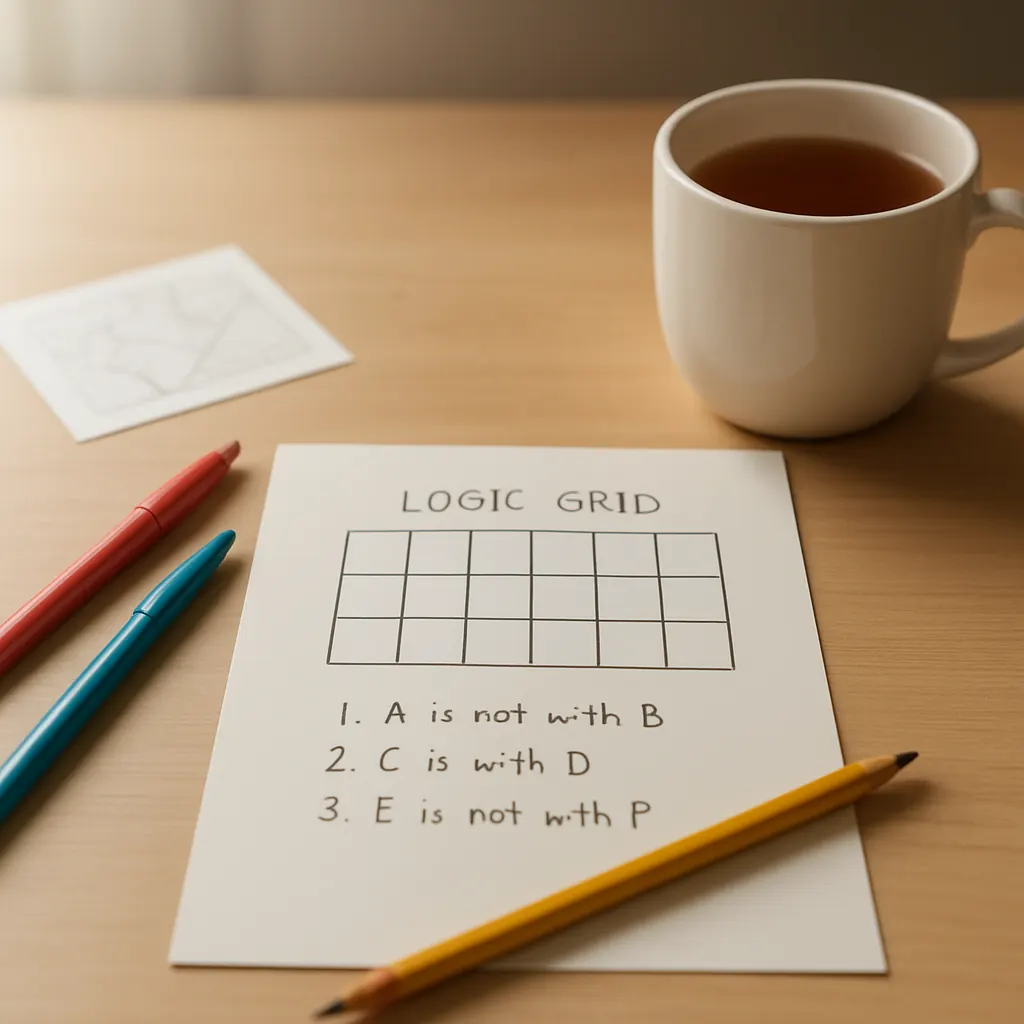
    • Draw a tiny 3×3 matrix to test a hypothesis (e.g., “If Alice=Red, then…”) and mark the resulting contradictions.
    • When a hypothesis leads to a contradiction, write a short note “Hyp A → contradiction” and mark the original hypothesis eliminated in the main grid.
    • Keep micro-maps deliberately temporary—cross them out when resolved to avoid clutter.

    Color cues without relying on color

    Color can be fast, but it isn’t always accessible or available. Combine simple color use with shapes and letters so your system still works in grayscale or for color-blind readers:

    • Use a single colored pen for confirmed items and a different pen for eliminations, but also add symbols (✓ and /) so meaning is clear without color.
    • If you label columns with colored initials, also include the initial letter or number inside the cell to avoid dependence on hue.

    Layout, margins and header abbreviations

    Good layout reduces searching time. A few layout rules I follow:

    • Reserve the top-left of the page for a short abbreviation key (e.g., A = Alice, R = Red).
    • Leave a wide right margin for micro-maps and conditional chains; this prevents overwriting grid cells.
    • Draw thin separator lines to group related columns or rows visually—these act as quick chunking cues for working memory.

    Before and after: a small example

    Imagine a 4×4 grid with people A–D and drinks Tea/Coffee/Juice/Water. Raw approach: write full names in each cell and cross out every elimination. The page gets messy and slows you down.

    After applying notation tricks:

    • Headers: A,B,C,D; drinks T,C,J,W with a short key at top.
    • Confirmations: mark A–T with • and write “A•T” in the margin.
    • Eliminations: use / in grid cells and keep possible candidates as small circles only in the margin micro-map for each person.
    • Conditional: when a clue implies “If C≠J then B=C,” write “C×J → B=C” in the right margin so the chain is visible without cluttering cells.

    Result: the grid shows only firm facts and eliminations; the margin contains the lightweight thinking steps that got you there.

    Short drills to practice notation

    Training the habit takes minutes. Try these five-minute drills:

    1. Set a one-clue challenge: draw a 3×3 grid, assign short headers, and spend three minutes listing every implication of that one clue in the margin using arrows and symbols only—no full sentences.
    2. Micro-map sprint: take a simple deduction puzzle or part of a larger puzzle and build a micro-map for one hypothesis. Stop after three minutes and decide: keep or eliminate the hypothesis.
    3. Cleanup drill: take a solved sample grid with heavy notes and spend four minutes converting it to a clean final grid—move tentative notes to the margin and mark confirmed items with a single symbol.

    These drills are ideal for short daily practice: the habit forms faster with repeated, focused attempts. If you want to practice notation in short sessions, repeat one drill per day for a week and review which shorthand stuck.

    When to go elaborate and when to stay simple

    Complex puzzles sometimes require more elaborate notation—multi-level micro-maps, numbered chains, or a second sheet for full hypothesis trees. For simpler puzzles, keep notation minimal so you don’t overthink. A useful rule of thumb: invest in more notation only if a hypothesis requires three or more linked deductions to resolve. See my note on how difficulty affects notation choices for a short guide to when to escalate your system.

    Final notes

    Notation should make solving calmer and clearer. Begin by adopting two or three symbols, a tiny margin micro-map habit, and a cleanup step at the end of each solve. Over weeks you’ll find which shorthand best matches your pace. The goal is not clever marks but fewer re-reads and steadier progress.