Why pick difficulty deliberately?
Not every puzzle deserves the same attention. Some days you want a calm few minutes of clarity; other days you want a deliberate stretch. Choosing the right difficulty for your moment preserves enjoyment and makes steady improvement easier. This article gives a compact, actionable framework you can use in under a minute.
The four quick axes
When you decide whether to open a puzzle, run it through four short questions. Treat each axis as a slider you set in your head.
1. Time (how long can I spend?)
Estimate available time in three buckets: under 10 minutes, 10–30 minutes, or 30+ minutes. If you have under 10 minutes, prefer puzzles labelled “bite-size” or with a single clear step. If you have 30+ minutes, you can accept multi-stage problems that reward planning.
2. Complexity (number of independent elements)
Complexity is about how many things you must track at once: a single word or grid cell vs. several interacting regions or rules. Low-complexity puzzles are easier to enter calmly; high-complexity puzzles need deliberate note-taking or a multi-stage plan.
3. Frustration index (how likely am I to hit a block?)
Estimate how often you expect to get stuck. A low frustration index means you’ll make steady progress; a high index means frequent dead-ends. If you’re in a relaxed mood, favor low-to-medium frustration. When you want a stretch, tolerate a higher index but keep a clear stopping rule (see routines below).
4. Learning value (small predictable gains vs. big unpredictable ones)
Ask whether the puzzle will reliably teach a repeatable technique in 10–20 minutes (high predictable learning) or whether its insights will be sporadic. For regular practice, prefer puzzles with clear, repeatable learning so small efforts compound.
Quick heuristics for common moods
Below are short settings for each mood. Use them as a checklist rather than absolute rules.
- Calm play: Time under 15 minutes, low complexity, low frustration index, modest learning value. Example: short word puzzles, a single logic mini-grid.
- Focused practice: Time 15–45 minutes, medium complexity, medium frustration, high predictable learning. Choose puzzles that emphasize a single technique you want to improve.
- Mental stretch: Time 30+ minutes, high complexity, higher frustration tolerated, high but variable learning. Use when you want deeper problem-solving practice and have an open schedule.
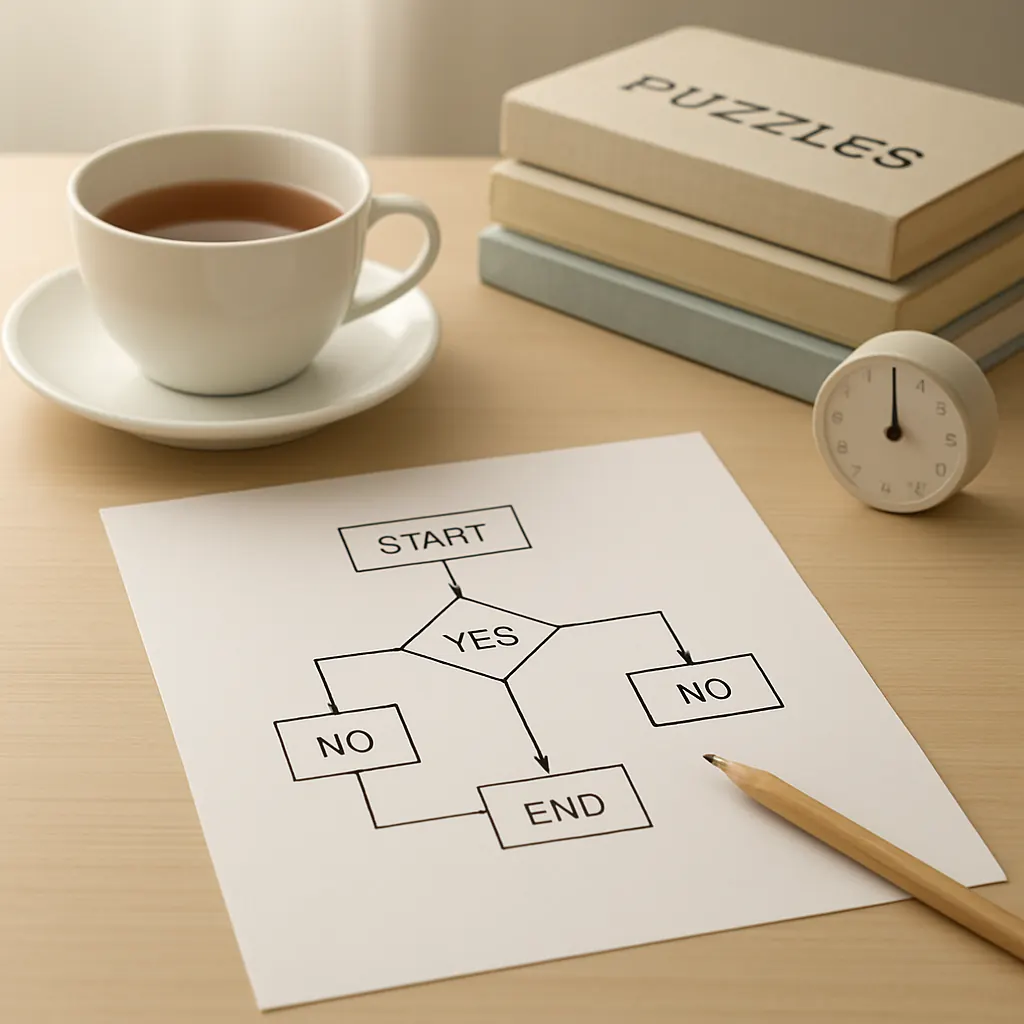
A one-question printable flowchart
Print this on a card or keep it on your phone. Ask the question and follow the one-step rule.
Question: How much time do I have right now?
- If under 10 minutes → pick a puzzle with low complexity and low frustration. Stop after 10 minutes or when you feel calm.
- If 10–30 minutes → pick medium complexity with predictable learning. Allow one deliberate hint if stalled for 8–10 minutes, then decide to continue or stop.
- If 30+ minutes → pick higher complexity and set a checkpoint at 30 minutes to reassess frustration and learning value.
This single question reduces decision fatigue: time bounds strongly predict which other axes you should tighten.
Three tiny routines to keep play calm
Use short routines rather than long rules. They’re easier to follow and build into daily life.
- Two-step entry: 1) Scan puzzle rules and note constraints (1–2 minutes). 2) Try the simplest guaranteed move. If none, move to the next puzzle or add a single note for later.
- Ten-minute checkpoint: When you start a longer puzzle, set a 10-minute timer. If you’re stuck at the checkpoint, either use one hint, switch to a lower-frustration segment, or stop and revisit later.
- Daily micro-practice: Pick one technique to practice for 10–20 minutes three times a week. This keeps learning value high without burning out.
When to switch and how to rescue a stalled session
If you hit a block, adopt a calm rescue plan: pause, mark where you are, and try a different angle for five minutes. If the block persists, switch to a simpler puzzle or take a short break. For guidance on adapting strategy when difficulty and mood change, see when to switch strategies if stuck.
Adjusting difficulty for accessibility
Difficulty isn’t one-size-fits-all. Adjust for sensory, motor, or cognitive accessibility by changing time, layout, or rule presentation. Simple changes include larger fonts, more contrast, fewer simultaneous elements, or allowing written notes. For a quick checklist to apply before you start, see adjust for accessibility needs.
Aligning with longer goals
If you follow a week- or month-long plan, make sure each day’s puzzle fits the time and learning axis of that plan. For example, if a weekly goal emphasizes learning a pattern, pick puzzles with predictable learning on practice days and reserve the mental-stretch puzzles for weekend sessions. For more on connecting difficulty to longer challenges, see matching difficulty to weekly goals.
Examples — three short pickers
- Five-minute reset: A single mini-crossword or a 3×3 logic microgrid. Time under 10 minutes, low complexity, low frustration.
- Targeted practice slot: 20 minutes solving puzzles that force one tactic (e.g., pattern elimination). Medium complexity, medium frustration, high predictable learning.
- Weekend challenge: A long-format puzzle with multiple interacting rules; allow two checkpoints and an open timer. High complexity and variable frustration, suitable for mental stretch.
Final note
Puzzle difficulty is a tool, not a badge. Use this framework to pick puzzles that match your time, energy, and goal for the session. Keep the one-question flowchart handy, use the short routines above, and adjust tools for accessibility so play stays calm and steady. Over weeks, this small habit of matching difficulty to mood will make play more rewarding and progress more reliable.