Tag: puzzle practice

  • Evaluating Puzzle Difficulty: A Simple Framework for Choosing Puzzles That Fit Your Mood

    Evaluating Puzzle Difficulty: A Simple Framework for Choosing Puzzles That Fit Your Mood

    Why pick difficulty deliberately?

    Not every puzzle deserves the same attention. Some days you want a calm few minutes of clarity; other days you want a deliberate stretch. Choosing the right difficulty for your moment preserves enjoyment and makes steady improvement easier. This article gives a compact, actionable framework you can use in under a minute.

    The four quick axes

    When you decide whether to open a puzzle, run it through four short questions. Treat each axis as a slider you set in your head.

    1. Time (how long can I spend?)

    Estimate available time in three buckets: under 10 minutes, 10–30 minutes, or 30+ minutes. If you have under 10 minutes, prefer puzzles labelled “bite-size” or with a single clear step. If you have 30+ minutes, you can accept multi-stage problems that reward planning.

    2. Complexity (number of independent elements)

    Complexity is about how many things you must track at once: a single word or grid cell vs. several interacting regions or rules. Low-complexity puzzles are easier to enter calmly; high-complexity puzzles need deliberate note-taking or a multi-stage plan.

    3. Frustration index (how likely am I to hit a block?)

    Estimate how often you expect to get stuck. A low frustration index means you’ll make steady progress; a high index means frequent dead-ends. If you’re in a relaxed mood, favor low-to-medium frustration. When you want a stretch, tolerate a higher index but keep a clear stopping rule (see routines below).

    4. Learning value (small predictable gains vs. big unpredictable ones)

    Ask whether the puzzle will reliably teach a repeatable technique in 10–20 minutes (high predictable learning) or whether its insights will be sporadic. For regular practice, prefer puzzles with clear, repeatable learning so small efforts compound.

    Quick heuristics for common moods

    Below are short settings for each mood. Use them as a checklist rather than absolute rules.

    • Calm play: Time under 15 minutes, low complexity, low frustration index, modest learning value. Example: short word puzzles, a single logic mini-grid.
    • Focused practice: Time 15–45 minutes, medium complexity, medium frustration, high predictable learning. Choose puzzles that emphasize a single technique you want to improve.
    • Mental stretch: Time 30+ minutes, high complexity, higher frustration tolerated, high but variable learning. Use when you want deeper problem-solving practice and have an open schedule.

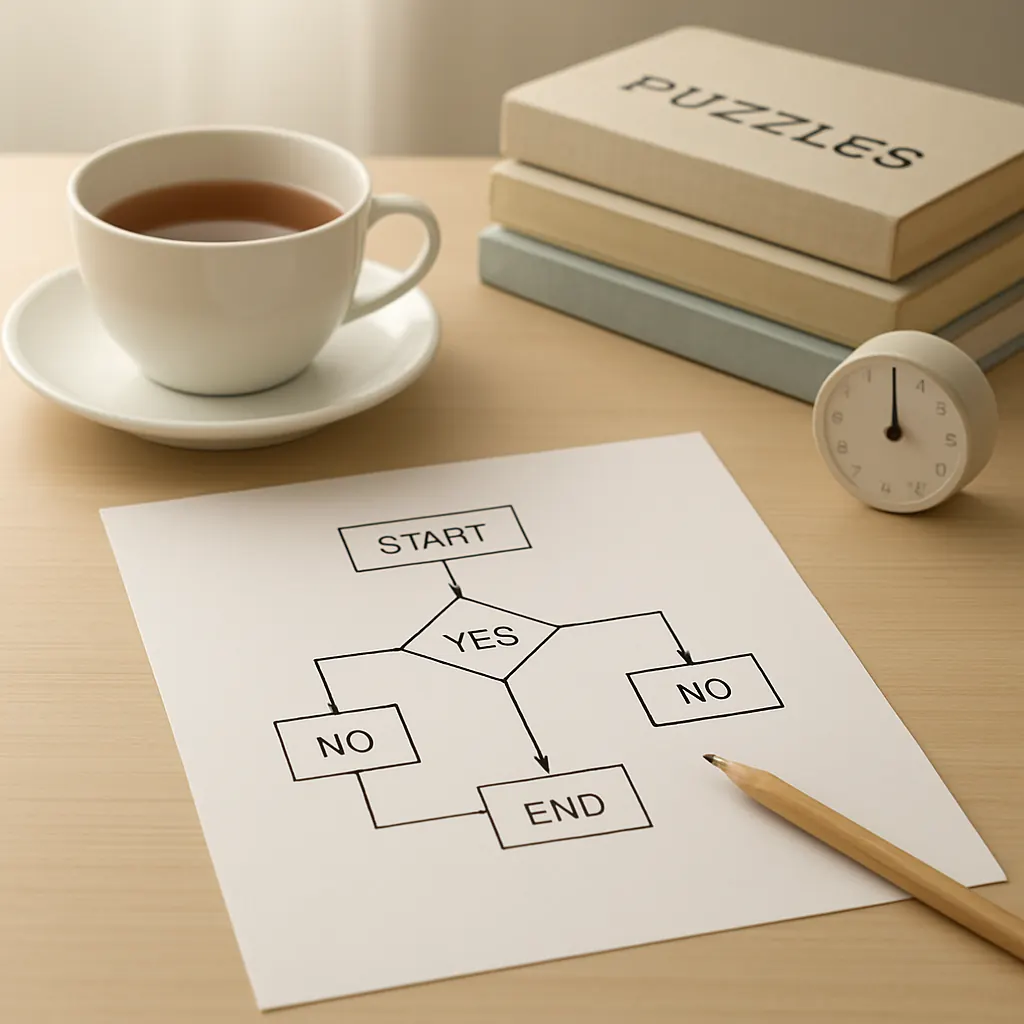
    A one-question printable flowchart

    Print this on a card or keep it on your phone. Ask the question and follow the one-step rule.

    Question: How much time do I have right now?

    1. If under 10 minutes → pick a puzzle with low complexity and low frustration. Stop after 10 minutes or when you feel calm.
    2. If 10–30 minutes → pick medium complexity with predictable learning. Allow one deliberate hint if stalled for 8–10 minutes, then decide to continue or stop.
    3. If 30+ minutes → pick higher complexity and set a checkpoint at 30 minutes to reassess frustration and learning value.

    This single question reduces decision fatigue: time bounds strongly predict which other axes you should tighten.

    Three tiny routines to keep play calm

    Use short routines rather than long rules. They’re easier to follow and build into daily life.

    • Two-step entry: 1) Scan puzzle rules and note constraints (1–2 minutes). 2) Try the simplest guaranteed move. If none, move to the next puzzle or add a single note for later.
    • Ten-minute checkpoint: When you start a longer puzzle, set a 10-minute timer. If you’re stuck at the checkpoint, either use one hint, switch to a lower-frustration segment, or stop and revisit later.
    • Daily micro-practice: Pick one technique to practice for 10–20 minutes three times a week. This keeps learning value high without burning out.

    When to switch and how to rescue a stalled session

    If you hit a block, adopt a calm rescue plan: pause, mark where you are, and try a different angle for five minutes. If the block persists, switch to a simpler puzzle or take a short break. For guidance on adapting strategy when difficulty and mood change, see when to switch strategies if stuck.

    Adjusting difficulty for accessibility

    Difficulty isn’t one-size-fits-all. Adjust for sensory, motor, or cognitive accessibility by changing time, layout, or rule presentation. Simple changes include larger fonts, more contrast, fewer simultaneous elements, or allowing written notes. For a quick checklist to apply before you start, see adjust for accessibility needs.

    Aligning with longer goals

    If you follow a week- or month-long plan, make sure each day’s puzzle fits the time and learning axis of that plan. For example, if a weekly goal emphasizes learning a pattern, pick puzzles with predictable learning on practice days and reserve the mental-stretch puzzles for weekend sessions. For more on connecting difficulty to longer challenges, see matching difficulty to weekly goals.

    Examples — three short pickers

    • Five-minute reset: A single mini-crossword or a 3×3 logic microgrid. Time under 10 minutes, low complexity, low frustration.
    • Targeted practice slot: 20 minutes solving puzzles that force one tactic (e.g., pattern elimination). Medium complexity, medium frustration, high predictable learning.
    • Weekend challenge: A long-format puzzle with multiple interacting rules; allow two checkpoints and an open timer. High complexity and variable frustration, suitable for mental stretch.

    Final note

    Puzzle difficulty is a tool, not a badge. Use this framework to pick puzzles that match your time, energy, and goal for the session. Keep the one-question flowchart handy, use the short routines above, and adjust tools for accessibility so play stays calm and steady. Over weeks, this small habit of matching difficulty to mood will make play more rewarding and progress more reliable.
  • A Minimalist Puzzle Journal: What to Track in 5 Lines per Day

    A Minimalist Puzzle Journal: What to Track in 5 Lines per Day

    Keeping a puzzle journal doesn’t need to be another long task on your to-do list. The goal of a minimalist journal is to preserve the benefits of reflection—tracking progress, spotting patterns, and reinforcing insights—without outweighing the pleasure of solving. This guide gives a one-page, five-line daily template you can use in a notebook or a notes app, examples to copy, and short review routines to make the journal meaningful.

    Why keep a tiny puzzle journal?

    A compact journal preserves the habit of reflection. When you capture one clear insight and a single metric each day, you build a data set that reveals trends (faster solves, recurring mistakes, preferred puzzle types) without needing long entries. It helps you make small, guided adjustments to your routine and gives you a low-friction way to remember techniques that worked.

    The 5-line daily template (one line = one short sentence)

    Each day, record five short items. Aim for one line each so the whole entry fits on a single row or a single note. Use abbreviations as needed.

    1. Time — how long you spent (e.g., 15m, 45m).
    2. Puzzle type — name or category (Crossword, Logic Grid, Nonogram, Daily Sudoku, Word Ladder).
    3. One insight — a single sentence: technique tried, mistake to avoid, or a small realization (e.g., “scan for singleton rows first”).
    4. One metric — a chosen difficulty or efficiency measure (see note below on which scale to use).
    5. Mood tag — one word that captures how it felt: calm, focused, frustrated, playful.

    Example line: 20m • Mini-Sudoku • Mark pencil candidates earlier • D4 • calm

    How to fill each line quickly

    • Time: use shorthand (m for minutes, h for hours). If you do several short puzzles, sum them or list as 3x10m.
    • Puzzle type: a 2–3 word label that you’ll recognize later.
    • One insight: force yourself to write only one sentence—this creates clarity and makes retrieval easy.
    • Metric: pick one simple scale and stick to it for trend analysis. For guidance on scales, see note puzzle difficulty.
    • Mood tag: keep a small list of tags (calm, focused, stuck, flow, amused) so entries are fast to choose.

    Two quick templates you can copy

    Printable (one row):

    DATE | TIME | TYPE | INSIGHT | METRIC | MOOD

    Digital (single-line note):

    2026-06-01 — 25m • Crossword • flag theme words first • D3 • focused

    If you use a simple note app, pin the monthly page and add a new line each day. If you use a notebook, reserve one page per month for quick scanning at the end of the period.

    Four short examples (realistic short entries)

    • 2026-03-05 — 15m • Wordle x2 • try vowel-first guesses • D2 • playful
    • 2026-03-06 — 40m • Logic Grid • mark contradictions immediately • D4 • focused
    • 2026-03-07 — 10m • Mini-Kakuro • re-evaluate row sums after fills • D3 • calm
    • 2026-03-08 — 30m • Daily Sudoku • pencil in all candidates once • D3 • flow

    Choosing the single metric to track

    Resist the urge to measure everything. Choose either a difficulty rating, a time efficiency metric, or a success rate and use it consistently. If you want help deciding which scale works for your session types, see note puzzle difficulty for practical options. Common choices:

    • Difficulty scale (D1–D5) for variety across puzzle types.
    • Time spent (minutes) for practice-focused days.
    • Percent complete or solved/attempted for goal-oriented weeks.

    Monthly review in 10–15 minutes

    At the end of each month, spend a short time scanning the page for patterns. Look for:

    • Repeated insights that can be turned into habits.
    • Shifts in average time or difficulty.
    • Frequent mood tags that tell you when puzzles felt most enjoyable.

    This minimalist approach pairs well with a month-long practice plan—if you follow a four-week challenge, your daily lines become the progress markers you need to track your 4-week progress. During the review, copy three notes to a fresh page: a habit to keep, a technique to practice next month, and one measurable target (e.g., reduce average time by 10%).

    Digital templates and quick automations

    If you prefer digital systems, keep the template in a notes app or a simple spreadsheet. Use a pre-filled template so adding a new line is one tap. For browser-based puzzle play, small browser extensions or note widgets can paste the current date and time into your template automatically. For a list of tools and suggested digital templates, see digital templates and tools.

    Accessibility and keeping it enjoyable

    Minimalist journaling is about keeping the entry cost tiny so you keep doing it. If writing is a barrier, record a 10–20 second voice memo that follows the five-line template and transcribe only monthly highlights. If small handwriting is a problem, use larger notebook lines or a simple digital form with big buttons.

    When to skip the journal

    If a session is purely recreational and you don’t want to break flow, skip the entry. The journal should help your practice, not become an obligation. A good rule: if you skip more than three sessions in a row, treat the next entry as a reset—write a single line noting why you paused and one small goal for getting back on track.

    Final notes

    A minimalist puzzle journal gives you the observational power of reflection with nearly no overhead. One clear insight per day, plus a consistent metric, produces useful data you can act on during a short monthly review. Use the five-line template in a notebook, a notes app, or a spreadsheet, and let the habit support calm, steady improvement.

  • Micro-Puzzle Sessions: 10-Minute Routines to Reset Your Mind

    Micro-Puzzle Sessions: 10-Minute Routines to Reset Your Mind

    Short, structured puzzle time can be a gentle way to reset during a busy day. This article lays out a dependable 10 minute puzzle routine you can use anywhere: three micro-sessions (a word-game sprint, a logic sketch, and a pattern quick-check), guidance for choosing puzzles that reliably fit the timebox, and a simple weekly schedule to keep momentum without stress.

    Why a 10-minute puzzle routine works

    Ten minutes is long enough to engage your attention and short enough to be friction-free. The constraint helps you focus on process over perfect solutions, and the predictable frame makes it easier to repeat daily. Treat the session as a small reset: clear focus for a fixed time, then return to your day refreshed.

    Start with two-minute warm-ups

    Begin each micro-session with a focused two-minute warm-up to shift your attention and loosen thinking. Try a single quick exercise—finger tracing a small pattern, a rapid anagram scramble, or a few arithmetic fact checks—to move your brain into puzzle mode. For more warm-up options, see two-minute warm-up exercises.

    Three micro-routines (each ~10 minutes)

    1) Word-game sprint (10 minutes)

    • What you need: a short word-game app, a printed mini-crossword, or a set of five anagram prompts.
    • How to run it:
      1. 00:00–02:00 — warm-up (simple three-letter anagrams or vowel-consonant drills).
      2. 02:00–08:00 — focused play on one puzzle type (e.g., attempt the mini-crossword or solve as many short anagrams as you can).
      3. 08:00–10:00 — review: note one strategy that helped or a word you learned.
    • Why it works: Word tasks support quick wins and vocabulary stretching without heavy cognitive load. Keep the format consistent so you can measure progress over weeks.

    2) Logic sketch (10 minutes)

    • What you need: paper and pen (or a notes app), and one small logic puzzle (5–8 clues, e.g., a short grid puzzle or a single binary-deduction problem).
    • How to run it:
      1. 00:00–02:00 — warm-up (a two-minute pattern recognition or rule-check task).
      2. 02:00–07:00 — sketch the puzzle visually: mark constraints, make a small grid, and test one hypothesis.
      3. 07:00–10:00 — consolidate: record one insight and either finish the puzzle quickly or label it for later revisit.
    • Why it works: The sketching step externalizes possibilities so you spend less time holding options in memory. This is especially useful when you only have a short slot.

    3) Pattern quick-check (10 minutes)

    • What you need: tactile or visual patterns: small Sudoku variants, sequence puzzles, or a set of five visual logic tiles.
    • How to run it:
      1. 00:00–02:00 — warm-up: scan a grid for obvious fills or symmetry cues.
      2. 02:00–08:00 — rapid passes: fill what you can with simple rules, avoid deep branching.
      3. 08:00–10:00 — stop and annotate: highlight the next two most promising moves for a future session.
    • Why it works: Pattern checks train quick recognition and let you make measurable steps in a small window. Annotating next moves keeps continuity between sessions.

    Choosing puzzles that fit 10 minutes

    Not every puzzle suits a micro-session. Favor tasks with clear, repeatable structures and limited branching so you won’t hit a frustrating dead end. For a practical method to judge puzzles by expected time and complexity, see choosing suitable micro-puzzles. In general:

    • Prefer compact puzzles with 1–3 decision points you can evaluate in a minute or two.
    • Use puzzle sets (five mini-crosswords, ten anagrams) so you can decide when you’ve spent your time.
    • Keep a small stash of short puzzles on your phone or printed cards to avoid search friction.

    Keep it light: a quick puzzle journal

    Logging a mini-session makes the habit stick without adding overhead. Record date, routine type, one short note (what you tried), and a single observation about enjoyment or a technique to repeat. For a ready-made template, see quick puzzle journal.

    Sample weekly schedule (compact and repeatable)

    Rotate the three micro-routines so each gets focus while keeping variety daily. This sample assumes one 10-minute session per weekday and a slightly longer weekend practice.

    1. Monday — Word-game sprint (vocab and quick wins)
    2. Tuesday — Logic sketch (structured thinking, pen-and-paper)
    3. Wednesday — Pattern quick-check (visual rules)
    4. Thursday — Word-game sprint (try a different format)
    5. Friday — Logic sketch (review a puzzle left open earlier)
    6. Saturday — 20-minute combined session: pick two micro-routines back-to-back.
    7. Sunday — Rest or review journal entries and plan the coming week.

    If you like a monthly structure, this approach fits neatly into a longer plan; see the four-week micro-session plan for a simple progression.

    Practical tips for consistency

    • Set a visible timer for exactly ten minutes to keep the session honest and finite.
    • Keep your puzzle tools ready in one place (app folder, printed cards, or a small notebook).
    • Treat sessions as non-competitive practice—focus on a tiny improvement or a pleasant moment rather than completion.
    • If a puzzle exceeds the timebox, mark the spot and move on; you can schedule a longer follow-up later.

    Micro-sessions are about steady, low-friction engagement. This 10 minute puzzle routine helps you refresh your attention, build small habits, and enjoy puzzles without commitment. Start with a two-minute warm-up, pick one focused routine each day, and use a quick journal note to close the loop. Over weeks, those small resets add up into calmer, more confident play.