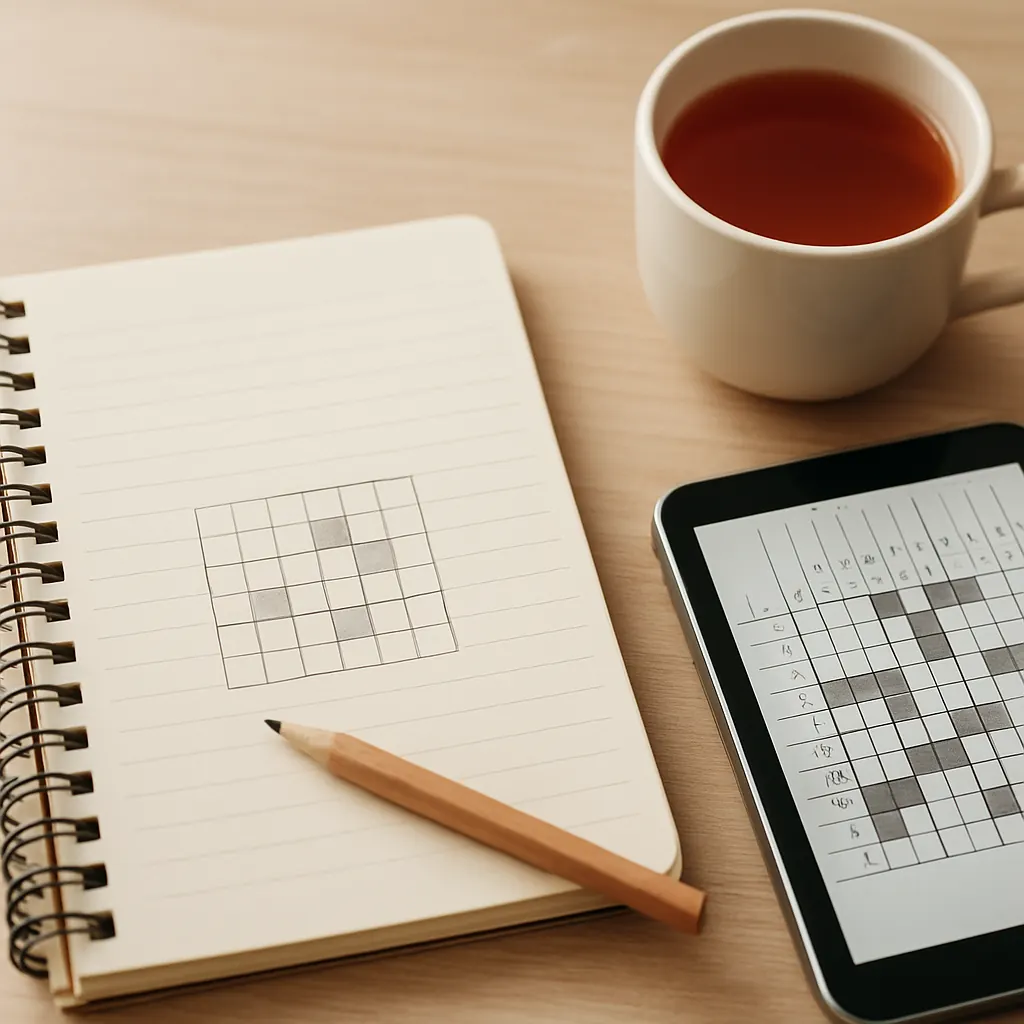
Why a warm-up matters
A five-minute warm-up before a puzzle session changes how you approach problems. It eases the transition from daily noise to focused thinking, primes pattern recognition, and gives you a quick feedback loop so you can adjust strategy before committing long effort. For calm, steady progress, a warm-up is not practice for speed; it’s practice for clarity.
Design principles for short warm-ups (2–5 minutes)
- Keep it bounded. Two to five minutes is enough to change your headspace without tiring you out.
- Be specific to the puzzle type. Different puzzles exercise different skills: deduction, visual segmentation, or lexical search.
- Practice one habit at a time. Use warm-ups to rehearse notation, pacing, or looking for certain patterns.
- Make it repeatable. A small set of drills you can do daily builds steady gains.
Warm-up drills by puzzle type
Logic-grid puzzles (2–4 minutes)
Focus: deduction flow and clean notation.
- Quick scan (30–45 seconds): read the scenario and write down the five key categories and one obvious elimination or match.
- Notation rehearsal (1–2 minutes): practice a small grid of 3×3 or 4×4 and apply one technique—fill all forced pairs, mark mutual exclusives, and draw any transitive connections. Treat this as a drill for your pen habits rather than solving the whole puzzle.
- One-chain check (30–60 seconds): create a short deduction chain from two clues: A→B and B→C, then confirm A→C on the grid. This trains you to spot chains during a real solve.
While you rehearse notation, you can intentionally apply notation shortcuts like condensed marks and consistent symbols. Practicing these for two minutes makes them automatic when you start a full puzzle.
Nonograms / Picross (2–5 minutes)
Focus: visual segmentation and range marking.
- Line-scan drill (1–2 minutes): pick a small 10×10 or even 5×5 grid from a daily feed. Scan rows and columns and mark any guaranteed fills or empties using the line-overlap method.
- Edge-fill practice (30–60 seconds): choose the three longest runs and practice aligning them to both ends—this helps with initial anchor placements.
- Symmetry and block counting (30–60 seconds): glance for mirror patterns and count contiguous runs quickly to build pattern recognition.
Word puzzles (crosswords, word searches, anagrams) (2–4 minutes)
Focus: lexical access and flexible pattern thinking.
- Anagram sprint (60 seconds): take a five- or six-letter seed word and list as many words as you can that use those letters. Time-box it—don’t overthink.
- Crossword letter-filling (1–2 minutes): choose two short clues and fill them based on pattern and crossing letters—practice accepting initial guesses and then checking them.
- Word family warm-up (30–60 seconds): pick a common affix (re-, un-, -ing) and generate words. This primes morphological patterns helpful in tougher clues.
Sample 5-minute routines
Before a morning session (fast clarity)
- One-minute breathing and desk reset (clear distractions).
- Two-minute logic-grid notation drill (forced pairs and one-chain check).
- Two-minute anagram sprint (lexical quickness).
Brief pre-puzzle reset (2–3 minutes)
- 30 seconds—scan the puzzle and set a simple goal (first three safe moves).
- 90 seconds—do one focused drill matching the puzzle type (line-scan for nonograms, notation rehearsal for grids, or anagram sprint for word games).
These short routines also help you fit warm-ups into short sessions, especially when you plan to solve for only ten minutes at a stretch.
Adapting drills to your level
- Beginner: Keep drills highly guided. For logic grids, use 3×3 practice sheets and verbalize each step as you mark the grid. Count aloud for nonogram runs. For word puzzles, allow clue lookup after an honest attempt.
- Intermediate: Increase complexity—4×4 grids, 10×10 nonograms, longer anagram seeds—and reduce explicit prompting. Add a one-minute speed constraint to build fluency.
- Advanced: Use targeted micro-challenges: find a subtle chain in a logic grid without writing everything down, resolve a single ambiguous nonogram block, or produce an uncommon anagram. Focus on precision over speed.
How warm-ups reduce frustration
Warm-ups lower the initial friction of a puzzle in three ways:
- Reduce decision cost: Rehearsing a first move or notation reduces the time you spend deciding how to start.
- Reset emotional baseline: A brief, successful drill gives you a small win that quiets impatience before tackling harder sections.
- Improve recovery tactics: If you hit a wall during a puzzle, switch to a one- to two-minute warm-up drill as a paced break—this is an active reset that prevents escalating frustration and preserves calm problem solving. See also calm techniques for tough puzzles for longer recovery methods.
Make it habitual
Start with a week of identical warm-ups so the routine becomes automatic. Track just the habit—open your puzzle app or notebook, do the two-to-five minute warm-up, then solve. After two to three weeks you’ll notice smoother starts, fewer careless errors, and a steadier sense of control.
Final checklist: building your personal warm-up
- Choose one drill per puzzle type that takes under five minutes.
- Decide a time block: 2 minutes (quick reset) or 5 minutes (full readiness).
- Pick one habit to practice in that drill (notation, edge fills, anagrams).
- Repeat the same routine for a week, then tweak complexity.
Warm-ups are small investments with consistent returns: clearer thinking, fewer mistakes, and calmer solving. Design a few compact drills, rehearse them, and let the routine guide you into better, more relaxed puzzle play.