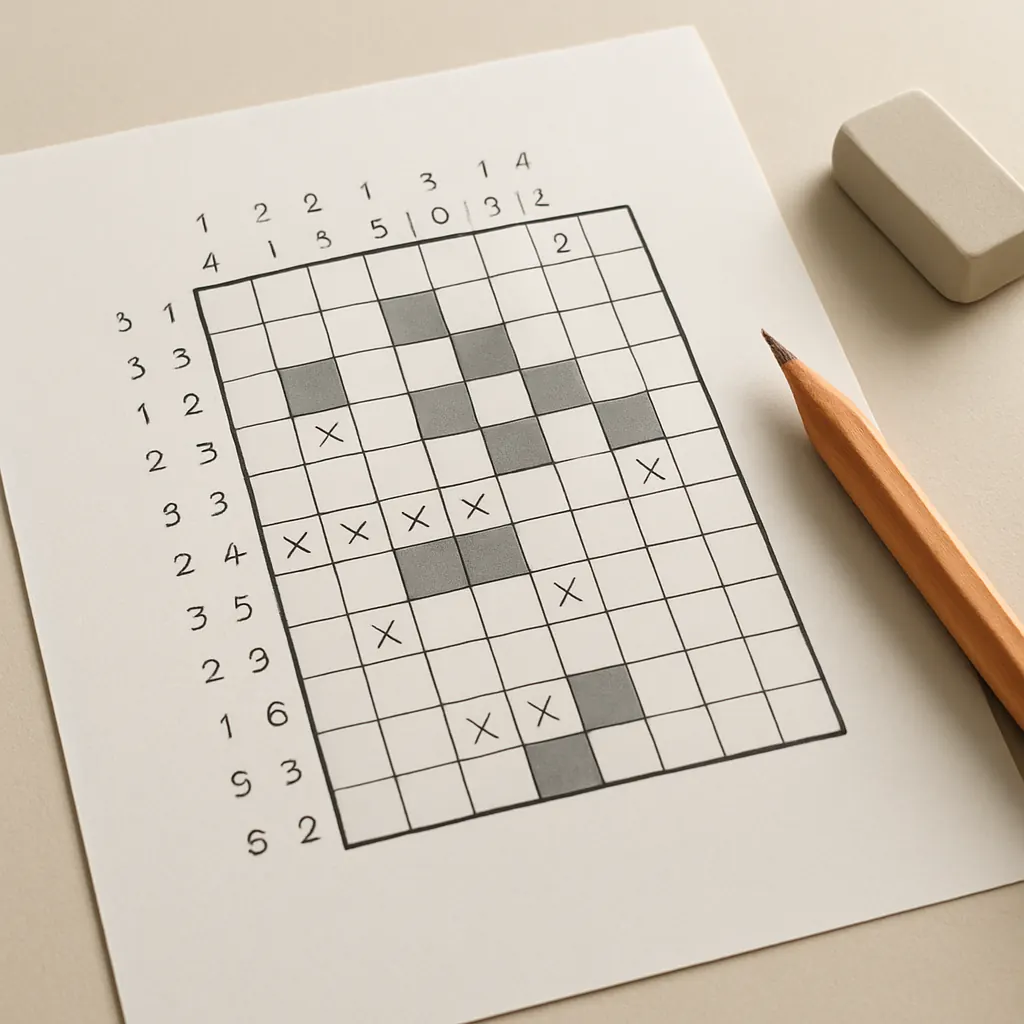
What a nonogram is — quick refresher
Nonograms (also called Picross or Griddlers) are logic puzzles where each row and column has number clues that describe runs of filled cells. Your goal is to fill cells so every clue matches the blocks of filled squares in that line, with at least one empty cell separating blocks. A small set of simple rules plus consistent methods make these puzzles approachable and calm to solve.
Tools and marks to use
- Filled mark — a solid square or shaded cell to show a definite fill.
- Empty mark — an X or light dot for cells you know must be blank.
- Number tracking — cross off a clue when you’ve satisfied that run so you know what remains.
Step-by-step solving method
Think of nonogram solving as repeating a small set of reliable steps until the grid is complete. Move calmly and check each row and column as new information appears.
-
Step 1 — Fill immediate certainties
Look for rows or columns with a single clue equal to the entire length (e.g., “5” in a 5-cell row) or a clue of zero. Fill every cell when the clue fills the entire line, and mark all cells empty when a clue is zero.
-
Step 2 — Use overlaps (the classic first move)
When a run is longer than half the line, there are guaranteed overlapping cells. For example, in a 10-cell line with a clue of 7, the run can start as early as cell 1 and as late as cell 4. The overlap (cells 4–7) are therefore guaranteed filled. Mark those, then mark empties at the extremes where a run cannot reach.
-
Step 3 — Cross-intersect rows and columns
After filling or marking empties in one direction, check intersecting lines. A filled cell in a row reduces possibilities in its column and vice versa. Use this intersection repeatedly — it’s the engine of most solutions.
-
Step 4 — Place forced gaps
Once part of a run is located, you often know that the cell next to it must be empty, because runs require separation. Place an X immediately after a confirmed block when necessary to prevent runs from merging incorrectly.
-
Step 5 — Use small-clue deductions
Short clues like 1 or 2 can create predictable patterns: isolated clues of 1 often go between empties, and a separated pair like “2, 1” in a tight space can force placement. Think locally and test whether a tentative placement creates a contradiction in the intersecting line.
-
Step 6 — Iterate and re-evaluate
After each change, re-scan the grid. New fills and empties often unlock further definite moves. Avoid guesses; prefer deductions that follow directly from the clues and marks.
Short example — a 5×5 walkthrough
Suppose a 5×5 puzzle has a top row clue of “3” and the grid is empty. A run of 3 in 5 cells can be positioned starting at cell 1, 2, or 3. The guaranteed overlap is cells 2–4, so shade them. Now check the corresponding columns — those filled cells reduce possibilities elsewhere and may create new overlaps.
As you mark empties next to that run and cross-check column clues, you’ll often force other rows to place their runs in single locations. Keep alternating directions until the puzzle resolves.
Common patterns and where they appear
- Edge fills — clues that reach the grid edge often push the run to one side, creating predictable empties and overlaps.
- Single-cell separators — occasionally a 1-clue sits between two larger clues; that central 1 will be isolated by empties on both sides.
- Symmetric constraints — many puzzles use symmetry visually, but don’t rely on it. Let the clues force placements.
If you want a short list of recurring visual patterns to recognize and speed up solving, read about general pattern-recognition techniques that apply across puzzle styles.
Typical beginner mistakes
- Guessing too early — avoid marking a cell filled unless you can deduce it logically. One wrong fill can mislead the whole grid.
- Forgetting to cross off satisfied clues — leaving lines unmarked makes it harder to see what remains; cross off runs as you complete them.
- Not updating both directions — every change in a row should prompt a column check and vice versa.
- Misplaced separators — placing an empty where a separating empty is not guaranteed can break future deductions.
Progressive exercises to build confidence
- Start with 5×5 or 10×10 puzzles that have many zeros and full-line clues to practice overlaps and edge fills.
- Move to mixed-clue puzzles where you must alternate rows and columns repeatedly; focus on cross-intersections rather than sweeping fills.
- Try medium-sized puzzles with several small runs (1s and 2s) to practice placing isolated blocks and forced gaps.
- Challenge yourself with larger 15×15 puzzles that demand patience and a disciplined marking habit.
When you practice, keep a record of errors and the type of deduction that fixed them. That habit turns mistakes into learning — try using a puzzle journal template to log patterns, missteps, and timing.
Cross-training: other deduction patterns
Nonogram logic overlaps with other pencil-and-paper puzzles. If you enjoy systematic elimination and inference, you may find value in reading about complementary techniques such as logic grid puzzle deduction patterns. The approach to consistent marking and chaining deductions is similar and strengthens your general puzzle intuition.
Final tips
- Work steadily and review rows and columns after every change.
- Use light marks for uncertain notes if you must hypothesize, but aim to convert them to definite marks quickly or erase them.
- Keep solving sessions short and calm—nonograms reward steady, focused work rather than frantic guessing.
With these steps, a few simple patterns, and steady practice, you’ll find most beginner nonograms become predictable and enjoyable. Pace your practice with progressive exercises and track your progress in a journal to see clear improvement over time.